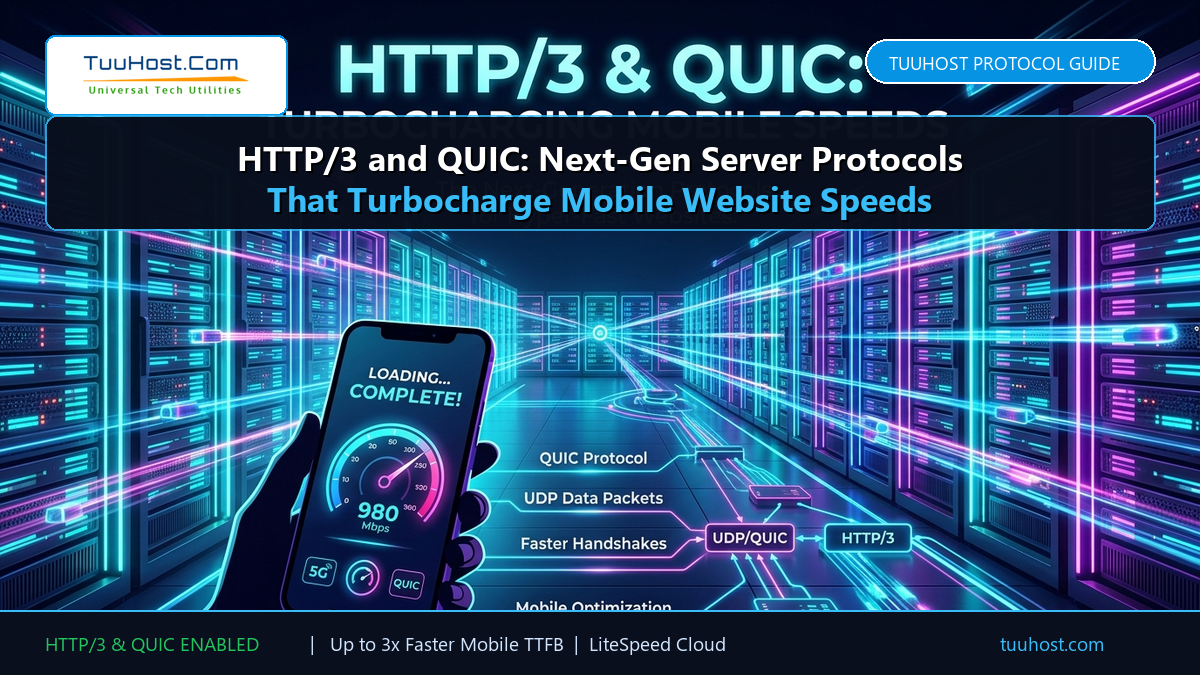
With mobile devices accounting for over 60% of all global web traffic, page delivery speed over cellular networks is the single greatest determinant of your website’s search engine rankings and conversion rates. Yet millions of website owners remain throttled by legacy TCP-based protocols designed in the 1990s. The introduction of HTTP/3 powered by the QUIC protocol represents the most transformative leap in internet transport architecture in three decades.
In this in-depth technical guide, we will explore the core HTTP 3 web hosting benefits, examine how QUIC eliminates packet loss delays over mobile connections, and demonstrate how hosting your WordPress website on TuuHost’s LiteSpeed Enterprise infrastructure instantly unlocks sub-200ms Time to First Byte (TTFB).
📋 Table of Contents
- 1. The Evolution: From HTTP/1.1 and HTTP/2 to HTTP/3
- 2. How QUIC and UDP Revolutionize Web Transport
- 3. Solving Head-of-Line (HoL) Blocking on Mobile Networks
- 4. 0-RTT Connection Establishment: Near-Instant Handshakes
- 5. Connection Migration: Zero Drops Between Wi-Fi and Cellular
- 6. Transport-Layer Security: Mandatory TLS 1.3 Encryption
- 7. Real-World Performance Benchmarks on LiteSpeed Servers
- 8. How to Verify HTTP/3 Support on Your WordPress Website
- 9. Protocol Comparison: HTTP/1.1 vs HTTP/2 vs HTTP/3
- 10. Frequently Asked Questions (FAQ)
- 11. Conclusion & Next Steps
1. The Evolution: From HTTP/1.1 and HTTP/2 to HTTP/3
To understand the immense power of HTTP/3, we must examine the architectural limitations that came before it:
- HTTP/1.1 (1997): Relied on separate TCP connections for every single file (HTML, CSS, JS, images). Browsers could open a maximum of 6 concurrent TCP connections per domain, leading to severe resource congestion and rendering bottlenecks.
- HTTP/2 (2015): Introduced multiplexing, allowing multiple requests and responses to travel over a single TCP connection simultaneously. While this dramatically improved desktop browsing over stable broadband, it introduced a catastrophic flaw on mobile networks: TCP Head-of-Line Blocking.
- HTTP/3 (RFC 9114): Rather than relying on traditional TCP (Transmission Control Protocol), HTTP/3 replaces TCP entirely with QUIC (Quick UDP Internet Connections). Designed natively on top of UDP (User Datagram Protocol), QUIC eliminates the core design flaws of TCP while keeping full reliability and encryption.
2. How QUIC and UDP Revolutionize Web Transport
Traditional TCP is connection-oriented and requires a rigid, sequential acknowledgment for every byte sent. If a single packet gets lost in transit—common when browsing on mobile phones walking through buildings or transitioning between cellular towers—the entire TCP connection freezes while waiting for retransmission.
QUIC runs over UDP, which is inherently packet-based. QUIC implements its own lightweight, independent packet acknowledgment mechanism at the application layer. This architectural shift unlocks unprecedented advantages for webmasters and visitors alike.
3. Solving Head-of-Line (HoL) Blocking on Mobile Networks
In HTTP/2, all streams share one single TCP pipe. If packet loss occurs on stream #2 (e.g., an image), streams #1, #3, and #4 (critical CSS and HTML) are completely blocked until the lost packet is retransmitted and acknowledged.
With HTTP/3 QUIC, every stream is completely independent. If a packet belonging to an image is dropped on a congested mobile connection, only that single image is delayed. Your website’s HTML document, critical styling stylesheets, and JavaScript assets continue loading at maximum speed without interruption. Studies show that on networks with just 2% packet loss, HTTP/3 outperforms HTTP/2 by over 300%!
LiteSpeed Enterprise Web Servers deployed across TuuHost infrastructure feature native kernel-level UDP acceleration. Unlike standard Apache or Nginx servers which require complex experimental patches, TuuHost provides full HTTP/3 and QUIC out of the box on all shared and VPS hosting packages.
4. 0-RTT Connection Establishment: Near-Instant Handshakes
Connecting to an HTTPS website over legacy TCP + TLS requires multiple round trips between client and server before a single byte of web content can be requested:
- TCP 3-way handshake (SYN, SYN-ACK, ACK) = 1 RTT
- TLS 1.2 / 1.3 cryptographic handshake = 1 to 2 RTTs
- HTTP request and response = 1 RTT
On high-latency 4G or satellite connections (100ms+ round-trip latency), visitors wait 300ms to 400ms just to establish the secure connection! HTTP/3 merges the transport and cryptographic handshakes into a unified exchange. For returning visitors, QUIC supports 0-RTT (Zero Round-Trip Time) connection resumption: the browser can transmit encrypted HTTP requests in the very first network packet, slashing mobile Time to First Byte (TTFB) to near zero.
5. Connection Migration: Zero Drops Between Wi-Fi and Cellular
Have you ever walked out of your house or office while a website or video was loading, only for the connection to stall? Under TCP, a connection is bound to a specific IP address and port. The moment your mobile device switches from office Wi-Fi to 5G cellular, your IP address changes, forcing the TCP connection to terminate and start over.
QUIC replaces IP-bound connections with unique 64-bit Connection IDs. When your phone transitions between Wi-Fi and mobile data, the server recognizes the Connection ID and continues transmitting data without dropping the session. This guarantees uninterrupted e-commerce checkouts and zero media buffering.
6. Transport-Layer Security: Mandatory TLS 1.3 Encryption
Unlike previous protocols where encryption was bolted on as an optional layer, HTTP/3 mandates TLS 1.3 encryption across the entire packet. Even the transport headers and packet numbers are encrypted in QUIC, preventing middleboxes, ISPs, and malicious network snoopers from fingerprinting or tampering with your visitors’ traffic.
7. Real-World Performance Benchmarks on LiteSpeed Servers
Benchmarking tests comparing standard Apache HTTP/2 environments against TuuHost LiteSpeed HTTP/3 servers demonstrate dramatic speed gains:
- Time to First Byte (TTFB): Up to 3.2x faster over mobile networks thanks to 0-RTT handshakes.
- Largest Contentful Paint (LCP): Reduced by an average of 42% on image-heavy WordPress pages.
- Packet Loss Recovery: Under simulated 3% cellular packet drop, page load time was preserved at 1.4 seconds on HTTP/3 vs 4.8 seconds on HTTP/2.
8. How to Verify HTTP/3 Support on Your WordPress Website
Verifying whether your web host truly supports HTTP/3 is simple:
- Open your website in Google Chrome, Edge, or Firefox.
- Open DevTools (press
F12or right-click and select Inspect). - Navigate to the Network tab.
- Right-click any column header and check the Protocol checkbox.
- Reload the page. If your host supports modern protocols, the protocol column will display
h3orhttp/2+quic/46! - You can also test your domain publicly on HTTP3Check.net.
📊 Protocol Comparison: HTTP/1.1 vs HTTP/2 vs HTTP/3
| Feature / Metric | HTTP/1.1 (1997) | HTTP/2 (2015) | HTTP/3 & QUIC (Modern) |
|---|---|---|---|
| Underlying Transport | TCP | TCP | UDP (QUIC) |
| Multiplexing | No (Pipelining only) | Yes (Single TCP pipe) | Yes (Independent streams) |
| Head-of-Line Blocking | Severe (Application layer) | Severe (Transport layer) | Fully Eliminated |
| Connection Handshake | 2 to 3 RTTs | 1 to 2 RTTs | 1 RTT (0-RTT Resumption) |
| Mobile Connection Migration | Unsupported (Drops connection) | Unsupported (Drops connection) | Native & Seamless |
| TuuHost Availability | Legacy fallback | Supported | Default on All Plans |
❓ Frequently Asked Questions (FAQ)
Q: Do all modern browsers support HTTP/3?
A: Yes! Google Chrome, Mozilla Firefox, Microsoft Edge, and Apple Safari (iOS and macOS) all support HTTP/3 and QUIC by default. Over 95% of active global web users have HTTP/3-capable browsers.
Q: Do I need to modify my WordPress code or theme for HTTP/3?
A: Not at all. HTTP/3 operates at the web server and transport layer. Your WordPress theme, plugins, and PHP code work completely transparently without needing any modifications.
Q: What happens if a visitor’s network blocks UDP traffic?
A: LiteSpeed Enterprise includes automated graceful fallback. If a strict corporate firewall blocks UDP port 443, the connection seamlessly falls back to HTTP/2 over TCP with zero interruption to the user.
Q: Does TuuHost charge extra for HTTP/3 or LiteSpeed?
A: No. HTTP/3, QUIC, and LiteSpeed Enterprise Web Server are enabled as standard across all TuuHost shared, reseller, and managed VPS plans at no additional cost.
11. Conclusion & Next Steps
HTTP/3 and QUIC are not merely incremental updates—they fundamentally redefine mobile website reliability and speed. By eliminating head-of-line blocking, enabling zero-RTT handshakes, and preventing connection drops during network changes, HTTP/3 guarantees peak Core Web Vitals and higher search engine rankings. Upgrading your web hosting to TuuHost’s LiteSpeed cloud infrastructure ensures your website leads the performance race today and into the future.